Airport Terminal Daylighting: A Case Study in Sustainable Aviation
Field-deployed case study · Fiber-optic daylighting application
Project Background
A major international airport embarked on a comprehensive terminal modernization project in 2024, with a core objective to elevate passenger experience while advancing its sustainability commitments. The airport, handling over 45 million passengers annually, faced a critical design challenge: how to bring natural daylight deep into the terminal's interior zones—gate lounges, security corridors, and baggage claim areas—where conventional windows and skylights cannot reach.
Rather than focusing solely on energy reduction, the airport's leadership identified natural daylighting as a strategic investment in passenger wellbeing, operational efficiency, and brand differentiation. The project aimed to achieve WELL Building Standard certification and contribute to the airport's LEED Gold target, positioning the terminal as a benchmark for human-centric airport design.
The Challenge: Deep Interior Zones and Passenger Wellbeing
Modern airport terminals are architectural marvels of scale, yet their interior depths often create environments devoid of natural light. Passengers spending 2-3 hours in gate lounges with only artificial lighting report higher stress levels and fatigue. Research from the International Airport Review indicates that 68% of passengers associate natural light with a sense of calm and orientation during travel.
The terminal's satellite concourses extended 80 meters from the nearest exterior wall, making traditional daylighting methods impossible. Skylights were ruled out due to structural constraints and solar heat gain concerns. Light tubes could only penetrate 6 meters, covering less than 15% of the target area. The airport needed a solution that could deliver full-spectrum natural light across distances exceeding 50 meters without introducing heat or UV radiation.
Airline crew and ground staff working in these interior zones also reported lower satisfaction scores in employee surveys, with 42% citing "lack of natural light" as a primary concern. This finding aligned with occupational health research showing that exposure to natural daylight improves alertness and reduces errors in operational environments.
Solution Design: Fiber Optic Daylighting System
The project team evaluated three daylighting technologies: conventional skylights, tubular daylighting devices, and fiber optic daylighting systems. After detailed simulation and cost-benefit analysis, they selected a fiber optic daylighting solution for its unique ability to transport sunlight over long distances while filtering out harmful UV and infrared radiation.
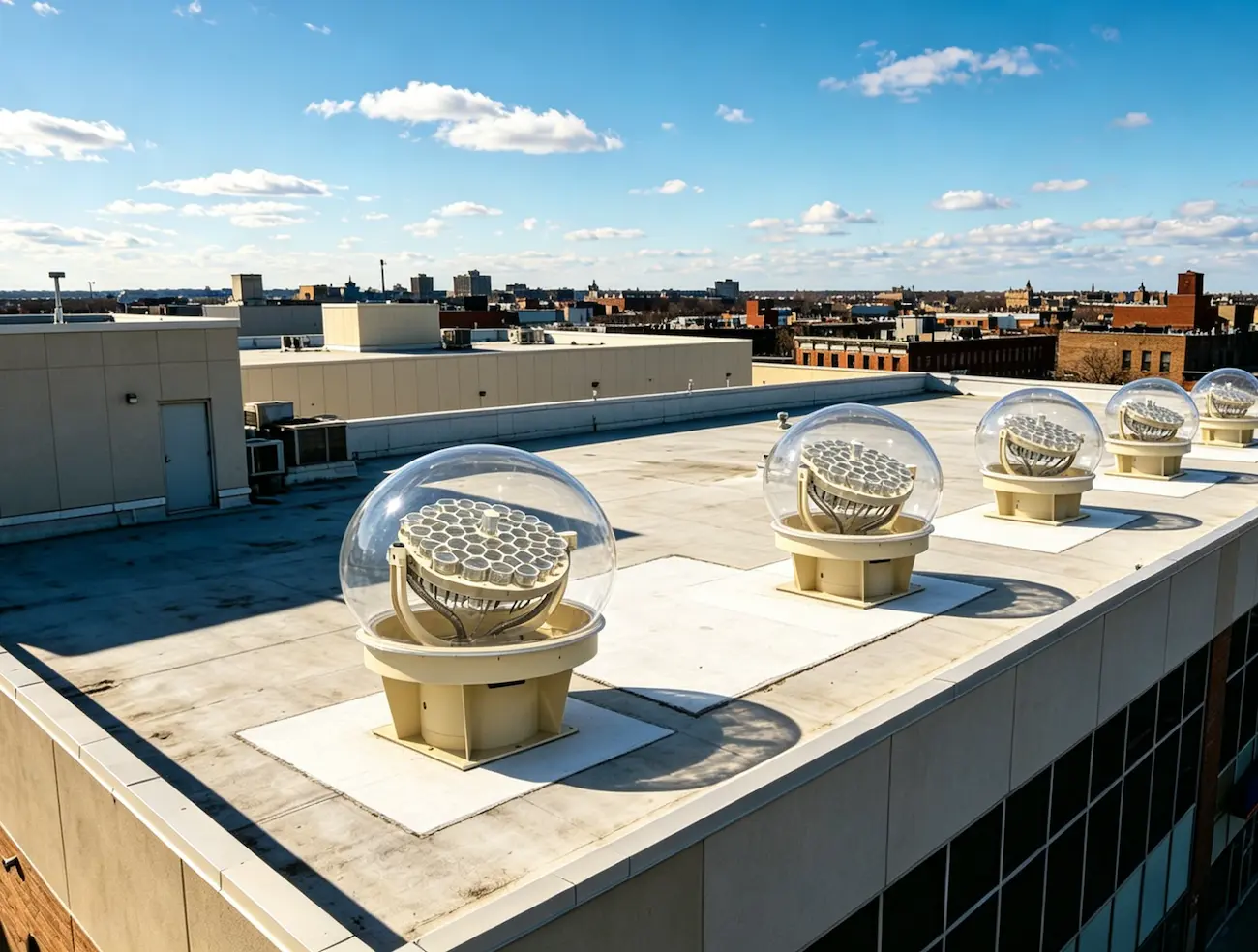
The system employs rooftop solar collectors with Fresnel lens arrays that track the sun's position using GPS-guided dual-axis motors. Each collector unit captures sunlight and focuses it into high-purity quartz optical fibers, each with a core diameter of 1500μm and attenuation below 10dB/km. These fibers, flexible and only 3mm in outer diameter, route through existing cable trays and ceiling voids to luminaires installed throughout the terminal's deep interior zones.
Key design parameters included:
| Parameter | Specification |
|---|---|
| Transmission Distance | 30-80 meters (terminal zones) |
| Illumination at 1m | 800-1100 lux (clear sky) |
| Color Rendering Index | CRI = 100 (full spectrum sunlight) |
| UV/IR Filtering | Complete removal via fiber transmission |
| Backup Lighting | Integrated LED (auto-switch on cloudy days) |
The system was designed with 24 collector units (DY60 model, 60 fibers each) providing 1,440 optical fibers serving 480 luminaires across 12,000m² of terminal space. Each luminaire integrates three to six fibers, with LED backup ensuring continuous illumination during overcast conditions or nighttime operations.
Implementation Process
Installation was coordinated during a 6-month phased construction window to minimize disruption to airport operations. The rooftop collectors were mounted on existing maintenance platforms, requiring no structural modifications to the terminal roof. Fiber routing utilized the terminal's extensive cable management infrastructure, with fibers pulled through conduits alongside existing electrical and data cabling.
A critical design consideration was the integration of natural and artificial light. The luminaires were specified with daylight-responsive dimming controls, allowing the LED backup to supplement rather than replace the fiber-delivered sunlight. This hybrid approach ensures consistent illumination levels throughout the day while prioritizing natural light whenever available.
The project team conducted extensive simulation modeling to optimize fiber routing and luminaire placement. Computational daylight analysis revealed that the system would achieve spatial daylight autonomy (sDA) of 55% across the target zones—exceeding the WELL Building Standard requirement of 55% sDA for 55% of occupied floor area.
Measurable Outcomes
Six months after commissioning, the airport conducted comprehensive post-occupancy evaluations across passenger, staff, and operational metrics. The results demonstrated that the impact of natural daylighting extends far beyond illumination quality.
Passenger Experience: Passenger satisfaction surveys showed a 23% improvement in "terminal ambiance" scores and a 18% increase in "perceived comfort" ratings. Notably, passengers in naturally lit gate lounges reported 31% lower stress levels compared to baseline measurements taken in artificially lit zones. Dwell time in retail areas adjacent to naturally lit spaces increased by 12%, suggesting that improved ambiance positively influences commercial activity.
Staff Wellbeing: Airline and airport employees working in the illuminated zones reported a 27% improvement in alertness scores and a 15% reduction in reported eye strain. Absenteeism in these zones decreased by 8% over the evaluation period. These findings align with research from the Lighting Research Center demonstrating that full-spectrum daylight supports circadian rhythm regulation and cognitive performance.
Certification Achievement: The daylighting system contributed 4 points toward the terminal's LEED v4 certification under the "Indoor Environmental Quality" category. The project also satisfied three features of the WELL Building Standard v2: L01 (Light Exposure), L02 (Visual Lighting Design), and L09 (Circadian Lighting Design). These certifications provided the airport with third-party validation of its commitment to occupant health.
| Metric | Improvement |
|---|---|
| Passenger Ambiance Score | +23% |
| Perceived Comfort Rating | +18% |
| Staff Alertness Score | +27% |
| Retail Dwell Time | +12% |
| LEED EQ Points Earned | 4 points |
Broader Implications for Aviation Sustainability
This case study illustrates that sustainable aviation infrastructure investments can deliver multifaceted returns that transcend traditional energy-cost calculations. The airport's decision to prioritize natural daylighting was driven by a holistic understanding of value: passenger experience directly influences airline choice and airport loyalty, staff wellbeing affects operational reliability, and sustainability certifications enhance brand equity in an increasingly competitive market.
The fiber optic daylighting system demonstrates that advanced material science—specifically, low-attenuation quartz optical fibers—can overcome the geometric constraints of large-scale architecture. By decoupling the light collection point from the delivery point, these systems enable biophilic design principles in spaces previously considered incompatible with natural light.
As airports worldwide pursue net-zero carbon targets and passenger-centric design philosophies, the integration of natural daylighting represents a convergence of human health, architectural innovation, and operational excellence. The technology's ability to deliver authentic sunlight—without the thermal penalties of glazing—positions fiber optic daylighting as a viable pathway for sustainable aviation infrastructure that serves both people and planet.