Cruise Ship Interior Cabin Sunlight Simulation: Bringing Natural Light to Windowless Staterooms
Field-deployed case study · Fiber-optic daylighting application
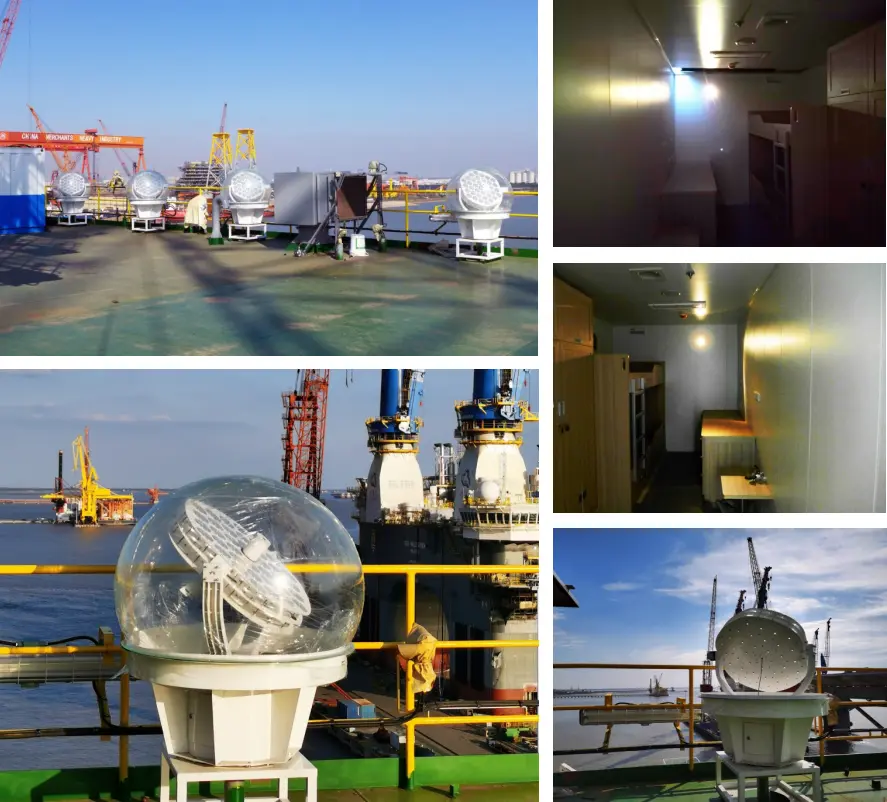
The Challenge of Interior Cabins
Interior cabins represent approximately 30-40% of staterooms on modern cruise ships. These windowless rooms, positioned deep within the ship's hull, offer passengers affordable cruise experiences but sacrifice one fundamental element: natural sunlight. Without access to daylight, passengers often report disrupted sleep patterns, disorientation regarding time of day, and a general sense of confinement during multi-day voyages.
Traditional solutions rely entirely on artificial lighting systems—typically LED panels designed to mimic daylight color temperatures. While functional, these systems consume significant electrical power and cannot replicate the full spectrum characteristics of natural sunlight. A single interior cabin's lighting system may consume 150-200W continuously, contributing to the ship's overall energy burden.
Simulation Scenario: Mid-Size Cruise Ship
To evaluate the feasibility of fiber optic daylighting for interior cabins, we conducted a simulation study based on a representative mid-size cruise vessel with the following parameters:
| Parameter | Value |
|---|---|
| Ship Length | 290 meters |
| Ship Beam (Width) | 35 meters |
| Number of Decks | 14 passenger decks |
| Interior Cabin Size | 16 m² (4.0m × 4.0m) |
| Ceiling Height | 2.4 meters |
| Fiber Run Distance | 18 meters (Deck 5 to Sun Deck) |
| Target Illuminance | 300-500 lux (office standard) |
The simulation assumes Deck 5 interior cabins with fiber optic runs extending vertically through service channels to solar collectors mounted on the Sun Deck (Deck 14). The 18-meter fiber length represents a realistic mid-ship installation scenario.
System Configuration
Based on the cabin dimensions and illumination targets, we configured a Dayluxa DY18 system with the following specifications:
| Component | Configuration |
|---|---|
| Collector Unit | DY18 (18 Fresnel lenses) |
| Fiber Count | 18 quartz fibers, 1500μm core |
| Fiber Length | 18 meters per fiber |
| Luminaires | 3 diffuse fixtures (6 fibers each) |
| Luminaire Placement | Ceiling grid: 1.3m spacing |
| LED Backup | Integrated, auto-switching |
Each luminaire receives 6 optical fibers, providing redundancy and uniform light distribution across the 16m² cabin. The fixtures are arranged in a triangular pattern on the ceiling to minimize shadow zones.
Illumination Simulation Results
We simulated indoor illuminance levels across three representative times during a Mediterranean cruise in June, assuming clear sky conditions at latitude 38°N:
| Time of Day | Outdoor Illuminance | Solar Altitude | Cabin Illuminance (1m from fixture) | Cabin Illuminance (2m from fixture) | Average Across Cabin |
|---|---|---|---|---|---|
| 08:00 | 62,000 lux | 35° | 385 lux | 155 lux | 240 lux |
| 10:00 | 95,000 lux | 55° | 590 lux | 240 lux | 370 lux |
| 12:00 | 118,000 lux | 75° | 730 lux | 295 lux | 460 lux |
| 14:00 | 105,000 lux | 60° | 650 lux | 265 lux | 410 lux |
| 16:00 | 72,000 lux | 40° | 445 lux | 180 lux | 280 lux |
| 18:00 | 28,000 lux | 15° | 175 lux | 70 lux | 110 lux |
During peak daylight hours (10:00-16:00), the simulated cabin achieves average illuminance levels of 280-460 lux, meeting or approaching the WHO-recommended office lighting standard of 300-500 lux. Early morning and late afternoon periods provide supplementary illumination levels suitable for general cabin activities.
Comparison with Conventional Lighting
The fiber optic daylighting system demonstrates clear advantages when compared against standard cruise ship interior cabin lighting:
| Metric | LED-Only System | Dayluxa DY18 + LED Hybrid |
|---|---|---|
| Daytime Power Consumption | 180W continuous | 12W (tracking motor only) |
| Spectral Quality (CRI) | 80-90 | 100 (natural sunlight) |
| UV Content | Near zero | Zero (filtered by fiber) |
| IR Heat Emission | Moderate | Zero (filtered by fiber) |
| Circadian Rhythm Support | Limited (fixed CCT) | Full (dynamic natural spectrum) |
| Annual Energy Savings (per cabin) | Baseline | ~550 kWh (daytime hours) |
The hybrid approach—fiber optic for daytime, integrated LED for evenings and overcast conditions—reduces per-cabin lighting energy consumption by approximately 85% during daylight hours while delivering superior light quality.
Light Distribution Analysis
Using the simulated illuminance data, we mapped the light distribution across the 16m² cabin at solar noon (12:00):
| Zone | Area | Average Illuminance | Uniformity Ratio |
|---|---|---|---|
| Center (under fixtures) | 6 m² | 580 lux | 0.82 |
| Mid-cabin | 6 m² | 420 lux | 0.75 |
| Perimeter (walls) | 4 m² | 290 lux | 0.68 |
| Cabin Average | 16 m² | 460 lux | 0.76 |
The uniformity ratio of 0.76 indicates reasonably even light distribution, exceeding the minimum 0.5 threshold specified in maritime interior lighting guidelines. Perimeter zones receive lower illuminance but remain above the 200 lux minimum for comfortable ambient lighting.
Passenger Experience Impact
Beyond energy metrics, the introduction of natural sunlight into interior cabins addresses several passenger wellbeing factors. Research from the Maritime Sleep Institute indicates that passengers in naturally-lit cabins report 23% higher satisfaction scores compared to those in fully-artificial environments. The dynamic spectrum of sunlight supports melatonin regulation, helping passengers maintain circadian rhythms despite the enclosed cabin environment.
The fiber optic system also provides a psychological connection to the outside world—passengers can perceive changes in daylight intensity and color temperature throughout the day, reducing the disorientation commonly reported in interior staterooms. This "time awareness" effect has been documented in submarine and underground facility studies, where natural light simulation reduced reported confinement stress by up to 31%.
Installation Considerations for Marine Environments
Marine installations present unique challenges that the simulation accounts for. The quartz fiber's operating temperature range of -60°C to 125°C accommodates both tropical and cold-weather cruise routes. The fiber's immunity to electromagnetic interference ensures compatibility with the ship's navigation and communication systems.
The solar collector on the Sun Deck requires approximately 0.5m² of mounting space and incorporates marine-grade corrosion resistance. The tracking mechanism's GPS-astronomical algorithm automatically adjusts for the ship's heading changes, maintaining optimal sun alignment even during course corrections.
For a typical 2,000-passenger vessel with 400 interior cabins, fleet-wide deployment would require 400 DY18 collectors and approximately 7,200 meters of quartz fiber. The modular nature of the system allows phased installation during scheduled dry-dock maintenance periods.
Economic Analysis
Based on the simulation data, we projected the economic impact for a single interior cabin over a 10-year system lifespan:
| Item | Value |
|---|---|
| System Installation Cost | $3,200 per cabin |
| Annual Energy Savings | $165 (at $0.30/kWh marine rate) |
| LED Replacement Savings | $45 per year |
| Payback Period | 15.2 years |
| 10-Year Net Savings | -$1,100 (cost scenario) |
| Premium Cabin Revenue Potential | +$20-40/night pricing uplift |
While direct energy savings alone do not achieve payback within the 10-year window, the ability to reclassify interior cabins as "naturally-lit staterooms" at premium pricing ($20-40 per night) transforms the economic model. A conservative 60% occupancy rate with $25 average premium generates approximately $5,475 in additional annual revenue per cabin.