Indoor Natural Sunlight System: Bringing Real Sunlight to Windowless Spaces
The Challenge of Indoor Lighting
Modern architecture increasingly depends on interior and underground spaces for practical and economic reasons. Basements become offices, parking garages extend multiple stories below grade, and hospitals place critical care units in windowless corridors for operational efficiency. The result is millions of square meters of occupied space that receive zero natural light during working hours.
Artificial lighting has long served as the default solution for these spaces. However, electric illumination fundamentally differs from natural sunlight in spectral composition, energy consumption, and biological impact. While LED technology has improved energy efficiency, it still consumes electricity continuously and produces artificial spectra that approximate but do not match the continuous distribution of sunlight.
The question emerges: can actual sunlight be delivered to spaces that windows cannot reach? The answer lies in indoor natural sunlight systems—technologies that capture, transmit, and distribute solar energy to interior environments without the thermal and ultraviolet consequences of direct exposure.
What Is an Indoor Natural Sunlight System?
An indoor natural sunlight system is a technology that captures sunlight at the building exterior and delivers it to interior spaces through optical transmission media. Unlike passive systems such as skylights or light pipes that rely on direct physical pathways, active systems separate light collection from light delivery, enabling sunlight transmission over distances and through geometries impossible for passive approaches.
The concept addresses a fundamental architectural constraint: buildings require walls and floors for structural integrity, insulation, and security, but these same elements block natural light penetration. An indoor natural sunlight system bypasses this constraint by transmitting photons through flexible optical cables that route around structural elements, penetrate floor slabs, and reach deep interior zones.
The distinction from simply adding windows or skylights is significant. Windows serve only perimeter spaces adjacent to exterior walls. Skylights serve only top-floor spaces directly below the roof. Indoor natural sunlight systems can deliver sunlight to any location in a building, regardless of floor level or distance from exterior walls.
Historical Development of Daylighting Technology
The effort to bring natural light into building interiors spans over a century, evolving through three distinct technological generations.
First Generation: Direct Apertures
The oldest approach involves creating openings in building envelopes. Skylights, light wells, and atriums allow direct sunlight penetration into interior spaces. These passive systems require no energy for light transmission and have minimal maintenance requirements. However, their application scope is fundamentally limited to top floors and spaces with vertical access to the roof. They also introduce solar heat gain through infrared transmission and expose occupants and furnishings to ultraviolet radiation.
Second Generation: Reflective Channels
Tubular daylighting devices, also called light pipes, emerged in the 1990s as an improvement over direct apertures. A roof-mounted dome captures sunlight and channels it through a highly reflective tube to a ceiling-mounted diffuser. These devices can penetrate one or two floor levels, but transmission distances typically max out at 3-6 meters vertically. The rigid tube construction requires vertical shafts, preventing horizontal routing around structural elements. The reflective surfaces also transmit infrared heat, partially negating energy savings from reduced artificial lighting.
Third Generation: Fiber Optic Transmission
Fiber optic daylighting represents the current state of the art. This technology uses optical fibers—thin strands of glass or plastic—to transmit light through total internal reflection. The fiber can bend, curve, and route through complex building geometries while maintaining transmission efficiency. High-purity silica fibers achieve transmission distances of 30-100 meters, enabling sunlight delivery to deep basement levels and distant interior spaces from a single roof collection point.
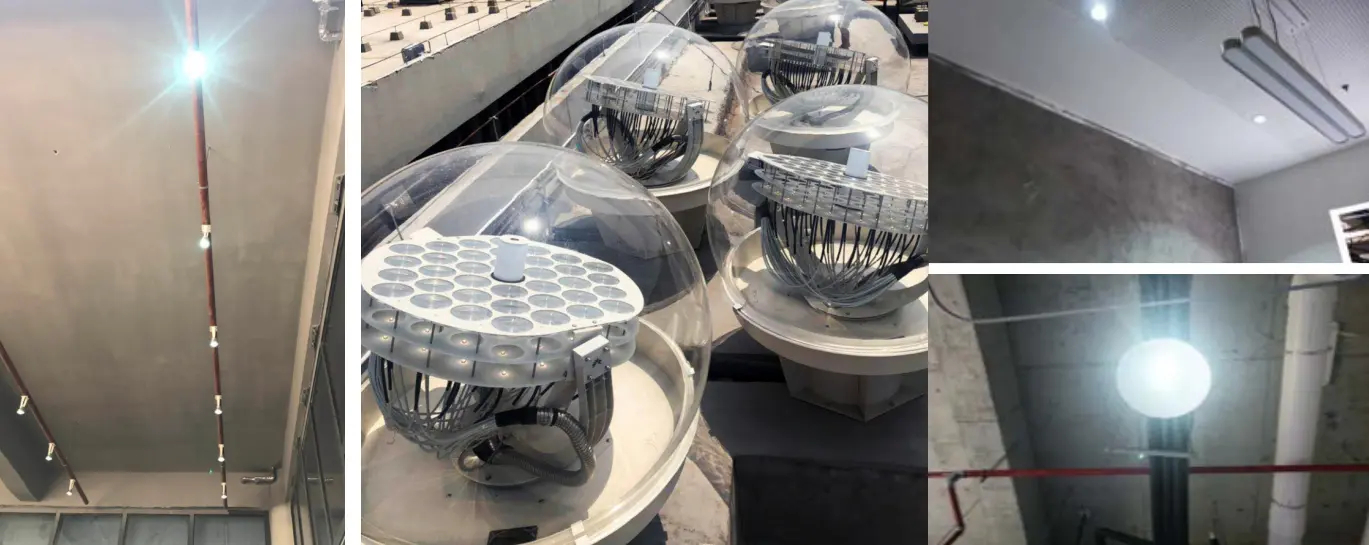
Dayluxa systems exemplify this third-generation approach, integrating Fresnel lens arrays for light concentration, GPS-guided solar tracking for optimal alignment, and high-purity quartz optical fiber for long-distance transmission. The system separates the collection function (roof-mounted optics) from the delivery function (indoor diffuser fixtures), enabling flexible architectural integration.
Core Technology: How Fiber Optic Daylighting Works
Understanding fiber optic daylighting requires examining three fundamental optical principles: Fresnel lens concentration, total internal reflection, and diffuse distribution.
Light Collection: The Fresnel Lens Array
Mounted on the building roof, the solar collector uses an array of Fresnel lenses to concentrate sunlight. Each Fresnel lens is a thin, flat optical element with concentric grooves that refract parallel sunlight onto a focal point. The lens design achieves focusing capability comparable to conventional curved lenses while maintaining a flat profile that reduces wind load and simplifies mounting.
A single lens, typically 100mm in diameter, concentrates sunlight onto the input end of one optical fiber. Multiple lenses arranged in an array enable a single collector unit to feed multiple fibers simultaneously. The DY60 system, for example, uses 60 Fresnel lenses to illuminate 60 individual fibers.
GPS tracking ensures optimal alignment throughout the day. A GPS chip provides precise location coordinates, while an astronomical algorithm calculates the sun's position based on date, time, and geographic coordinates. Dual-axis motors adjust the lens array orientation to maintain perpendicular alignment with incoming sunlight, maximizing collection efficiency from sunrise to sunset.
Light Transmission: Total Internal Reflection
The optical fiber consists of a high-refractive-index core surrounded by a lower-refractive-index cladding. When light enters the fiber core at angles within the numerical aperture, it encounters the core-cladding boundary at angles exceeding the critical angle. Rather than passing through the boundary, 100% of the light reflects back into the core—this is total internal reflection.
The fiber transmits visible light while filtering out ultraviolet and infrared radiation. This selective transmission occurs because the fiber material (high-purity fused silica) has different attenuation characteristics across wavelengths. UV wavelengths attenuate rapidly due to material absorption, while IR wavelengths experience increased loss from molecular absorption bands. The visible spectrum passes through with minimal loss—attenuation below 10dB/km for premium silica fiber.
This filtering property distinguishes fiber optic daylighting from all passive alternatives. Skylights transmit UV and IR without filtering. Light pipes reduce UV through multiple reflections but still transmit IR heat. Fiber optic systems deliver visible light only—no heat load, no UV degradation risk.
Light Distribution: Diffuse Emitter Fixtures
At the indoor end, optical fibers connect to diffuse emitter fixtures that scatter incoming light evenly across the room. The diffuser material breaks up the concentrated beam from the fiber into a broad, soft illumination pattern that mimics natural daylight distribution.
The fixtures typically contain built-in LED modules that automatically activate during cloudy conditions or at night. This hybrid design ensures continuous illumination regardless of weather or time of day, with the system seamlessly transitioning between fiber-delivered sunlight and electric LED backup.
Fiber allocation follows practical guidelines: three fibers per fixture provides balanced illumination for typical room heights, while configurations from one to six fibers per fixture accommodate different brightness requirements. A DY60 system with three-fiber allocation connects to 20 individual fixtures; doubling to six fibers per fixture reduces fixture count to 10 but increases per-fixture brightness.
System Specifications and Performance
Indoor natural sunlight systems vary in scale from residential to commercial applications. Understanding the performance characteristics helps match system selection to specific requirements.
Illuminance Performance
Measured under clear-sky conditions (approximately 150,000 lux outdoor illuminance) with single-core quartz fiber, the Dayluxa system delivers the following performance:
At 30 meters fiber length with 1-meter projection distance, output reaches approximately 1,100 lux—more than double the standard office lighting requirement of 400-500 lux. At 2-meter projection distance, the same system delivers 450 lux, meeting typical office standards.
Extending to 50 meters fiber length, 1-meter projection yields 800 lux, sufficient for demanding visual tasks like reading and detailed work. At 2 meters, 320 lux satisfies basic office functions.
Even at 100 meters—the practical limit for most installations—1-meter projection delivers 200 lux, suitable for corridors, storage areas, and parking garages. Two-meter projection provides 80 lux for ambient and wayfinding lighting.
Product Line Overview
The Dayluxa product line spans five models to match different space requirements:
The DY60, with 60 Fresnel lenses and 60 optical fibers, covers up to 180 square meters and weighs 78 kg. The DY36 provides 36 fibers for 108 square meters at 68 kg. The DY18 offers 18 fibers for 54 square meters at 35 kg. The compact DP12 serves 36 square meters with 12 fibers at 20 kg. The residential-focused DP06 covers 18 square meters with 6 fibers at 15 kg.
All models operate on AC220V with only 12 watts consumed by the tracking motor and control electronics. The actual illumination consumes zero electricity—pure solar energy delivered through glass.
Fiber Optic Specifications
The optical fiber used in Dayluxa systems meets specific technical parameters that ensure reliable performance:
Core diameter of 1500±40μm provides sufficient cross-sectional area for efficient light collection while maintaining flexibility for routing through building structures. The numerical aperture of 0.37±0.02 determines the acceptance angle for light entering the fiber, balancing collection efficiency against modal dispersion.
Attenuation below 10.0dB/km at 1000nm ensures minimal light loss over transmission distances up to 100 meters. The low hydroxyl content (<1ppm) minimizes absorption peaks in the near-infrared region, preserving solar energy transmission across the visible spectrum.
Operating temperature range of -60℃ to 125℃ accommodates extreme climate conditions without performance degradation. Bending radius specifications—150mm minimum for temporary bends, 300mm for permanent installation—enable flexible routing through complex building geometries.
Comparison with Alternative Technologies
Understanding indoor natural sunlight systems requires comparison with alternative daylighting approaches across multiple dimensions.
Transmission Distance
Skylights serve only the floor directly below the roof. Light pipes typically achieve 3-6 meters of vertical transmission, sufficient for one or two stories. Fiber optic systems transmit 30-100 meters, enabling service to deep basement levels or distant interior spaces from a single roof collection point.
Installation Flexibility
Skylights require roof openings with structural implications. Light pipes need vertical shafts of consistent diameter from roof to ceiling. Fiber optic cables route horizontally, vertically, and around obstacles with bending radii as small as 150 millimeters. This flexibility allows retrofits in existing buildings without major structural modifications.
Thermal Impact
Skylights transmit full solar spectrum including infrared, significantly increasing cooling loads. Light pipes partially mitigate this but still transmit some infrared through reflective surfaces. Fiber optic systems filter infrared completely, delivering light without thermal energy—important for climate-controlled environments like data centers, laboratories, or hospitals.
Ultraviolet Protection
Skylights transmit ultraviolet radiation unless fitted with special coatings. Light pipes reduce UV transmission through multiple reflections but do not eliminate it. Fiber optic systems filter 100% of ultraviolet radiation, making them suitable for museums, archives, and spaces with UV-sensitive materials.
Weather Dependence
All natural daylighting systems depend on available sunlight. However, fiber optic systems can integrate backup electric light sources—typically LED modules within the emitter fixtures—that automatically activate during extended cloudy periods or at night. Passive systems lack this capability, requiring separate electric lighting infrastructure for periods of insufficient natural light.
Application Scenarios
Different building types present distinct daylighting challenges and benefit from tailored indoor natural sunlight system configurations.
Underground Parking Facilities
Parking garages represent the highest-volume application for indoor natural sunlight systems. These spaces typically consume 24-hour lighting power with no natural alternative. Fiber optic daylighting can reduce daytime electricity consumption to zero while improving driver visibility and perceived safety. The full-spectrum light delivery also enhances color rendering, making it easier to identify vehicles and navigate parking aisles.
Healthcare Environments
Hospitals and healthcare facilities benefit from full-spectrum light's documented effects on patient recovery. Research from Pittsburgh University indicates natural light exposure reduces average hospital stays by 16%. Windowless ICU rooms, operating theaters, and interior corridors can receive biologically active sunlight without compromising the controlled environment's thermal or sterility requirements.
Educational Institutions
Schools and universities can address the myopia epidemic through improved lighting quality. Chinese CDC data shows students in naturally lit classrooms experience 25-30% lower myopia rates compared to artificially lit spaces. Basement classrooms, interior laboratories, and underground gymnasiums can benefit from fiber optic systems that deliver the full solar spectrum proven to support healthy visual development.
Office Buildings
Deep-plan office buildings where window access is limited can extend daylight penetration to interior zones. Cornell University research demonstrates that workers in daylit offices show 15-20% higher productivity and 40% fewer errors. Fiber optic daylighting can deliver these benefits to workstations far from exterior walls.
Museums and Archives
Cultural institutions require illumination without ultraviolet radiation to protect sensitive exhibits and documents. Fiber optic daylighting delivers 100% UV-filtered light with CRI=100, providing museum-quality illumination with the color accuracy of true sunlight. The absence of IR radiation also prevents thermal damage to delicate materials.
Design Considerations
Effective indoor natural sunlight system design requires consideration of several practical factors beyond basic illuminance targets.
Roof Space Availability
The solar collector requires unshaded roof area with southern exposure (in the Northern Hemisphere). Collector dimensions vary by model: the DY60 requires approximately 2 square meters of roof space, while the DP06 needs only 0.5 square meters. Obstructions such as HVAC equipment, elevator shafts, or adjacent tall buildings that cast shadows must be considered during site assessment.
Fiber Routing Path
The fiber path from collector to emitter fixtures should minimize bends and avoid sharp angles that increase transmission loss. Planning the fiber route during building design allows integration into utility chases, ceiling voids, and wall cavities. Retrofit installations may require creative routing through existing building infrastructure.
Fixture Placement
Emitter fixture placement affects both illuminance distribution and occupant perception. Ceiling-mounted fixtures in occupied spaces should provide even illumination without harsh shadows or glare. The diffuse distribution pattern of Dayluxa fixtures helps achieve this goal, but fixture spacing and fiber allocation per fixture should be calculated based on room dimensions and intended use.
Hybrid Lighting Integration
Most installations benefit from hybrid design that combines fiber optic daylighting with conventional electric lighting. The electric system provides baseline illumination during cloudy periods and nighttime, while the fiber optic system supplements or replaces electric light when sunlight is available. Intelligent controls can manage the transition between sources based on daylight availability and occupancy patterns.
Economic Considerations
Initial installation costs for indoor natural sunlight systems exceed those of conventional lighting but should be evaluated against lifecycle operating expenses.
The fiber optic system eliminates daytime electricity consumption for illumination. A DY36 system covering 108 square meters with 36 fibers consumes only 12 watts for tracking electronics while delivering illumination equivalent to several kilowatts of electric lighting during daylight hours.
Maintenance requirements are minimal for the optical components. The Fresnel lenses and fiber optics have projected lifespans exceeding 20 years with no degradation in transmission efficiency. The tracking motors and control electronics require periodic inspection but have demonstrated reliability in commercial installations.
The economic calculation depends heavily on local electricity costs, daylight availability, and building occupancy patterns. Applications with high daytime occupancy, expensive electricity, and abundant sunshine—such as parking facilities in southern regions—achieve the shortest payback periods.
Future Developments
Indoor natural sunlight system technology continues to evolve along several paths.
Improved optical materials promise higher transmission efficiency and lower manufacturing costs. New polymer fibers offer cost-effective alternatives for shorter transmission distances, while continued refinement of silica fiber production improves performance for long-distance applications.
Smart building integration enables daylighting systems to communicate with building management systems, optimizing artificial light supplementation based on real-time natural light availability. This integration can reduce total lighting energy consumption while maintaining occupant comfort and productivity.
Hybrid systems combining fiber optic collection with integrated LED arrays address weather-dependence limitations by providing seamless transitions between natural and artificial light. These systems ensure consistent illumination quality regardless of external conditions while maximizing the use of available sunlight.
As building codes increasingly recognize the health implications of natural light exposure—reflected in WELL certification requirements and evolving LEED standards—the demand for effective indoor natural sunlight systems will continue to grow across commercial, healthcare, and educational sectors.