When Daylight Needs a Motor: What Active Daylighting Actually Means
The Space That Was Never Meant to See the Sun
At noon on a clear day, a building's roof receives about 150,000 lux of sunlight — enough to illuminate every room inside several times over. Three floors below ground, in the same building, a 200-square-meter monitoring room operates under 40 LED panels pulling 2,400 watts, producing 500 lux of artificial light indistinguishable from any other underground facility. The sunlight is free, abundant, and full-spectrum. The distance between it and the people working below: roughly 35 meters of concrete, rebar, and ductwork. The question isn't whether those 35 meters matter. The question is what technology can bridge them.
Not every room gets a window — an architectural fact that predates modern construction. But the scale of windowless space has changed. Underground parking garages sprawl across multiple levels. Data centers, archives, and server rooms live below ground for thermal stability. Basement offices, underground retail, subway concourses — collectively, millions of square meters of occupied space were never designed to receive a single photon of natural light.
The people who work in these spaces adapt. They install brighter LEDs. They buy full-spectrum bulbs. They add task lighting. But they've been solving the wrong problem. The issue isn't whether a space feels bright enough. It's whether the light reaching a person's retina contains the full spectral signature that the human body evolved under for roughly 300,000 years.
When Cornell University researchers compared office workers on two identical floors — one with natural daylight, one without — the daylight group completed cognitive tasks 15-20% faster. But the deeper finding wasn't about speed: their error rate dropped. Natural light doesn't just make people work faster; it makes them work more accurately. Harvard Medical School studies linked long-term absence of natural light to melatonin secretion peaks delayed by 2-3 hours — meaning the body's deep repair cycle is compressed even when a person sleeps eight hours. This isn't a "not enough light" problem. It's a "biological clock was never calibrated" problem.
And yet, most underground spaces were designed without any plan for solving it. For most of architectural history, the answer was obvious: you can't get sunlight into a space without a straight-line path to the sky.
The Physics Ceiling of Passive Daylighting
Passive daylighting is the architecture of straight lines. A skylight works because nothing sits between the glass and the sun. A light well works because a vertical shaft connects roof to interior. A tubular daylighting device works because polished aluminum can bounce light down a short, straight path.
Each of these solutions operates under the same unspoken rule: light must travel in an unobstructed line from collection point to delivery point. And each hits its limit quickly.
A skylight serves the top floor. For every floor below, the ceiling isn't the roof — it's another slab of concrete. A light well can reach deeper, but only if the building was designed with a vertical shaft from the start. Retrofitting one means cutting through slabs, rerouting utilities, and often violating fire compartmentation codes. Tubular daylighting devices — products like Solatube and Velux sun tunnels — extend the reach somewhat, but they're constrained by the reflectivity of their internal surfaces. Every bounce off the reflective wall costs light. By 3 meters, roughly 40% of the captured light is gone. By 6 meters, what remains is too dim for anything beyond basic ambient glow.
This is the glass ceiling of passive daylighting. Passive systems don't amplify light. They don't steer it. They don't make decisions. They offer a channel and trust physics to deliver. For spaces within 6 meters of the roof, that trust holds. For everywhere else, it breaks.
Enter an architectural problem with no passive solution: a basement classroom 20 meters underground. A museum conservation room on floor B2. A hospital waiting area embedded in a building core with zero perimeter exposure. These spaces don't need a slightly better reflective tube. They need a fundamentally different approach to what "bringing in sunlight" means.
What Makes a Daylighting System "Active"
Active daylighting isn't a refined version of passive daylighting. It's a different category of technology — one where the system makes real-time decisions about how to collect, concentrate, and distribute light. The word "active" refers to three operations a passive system never performs: it tracks, it concentrates, and it transports.
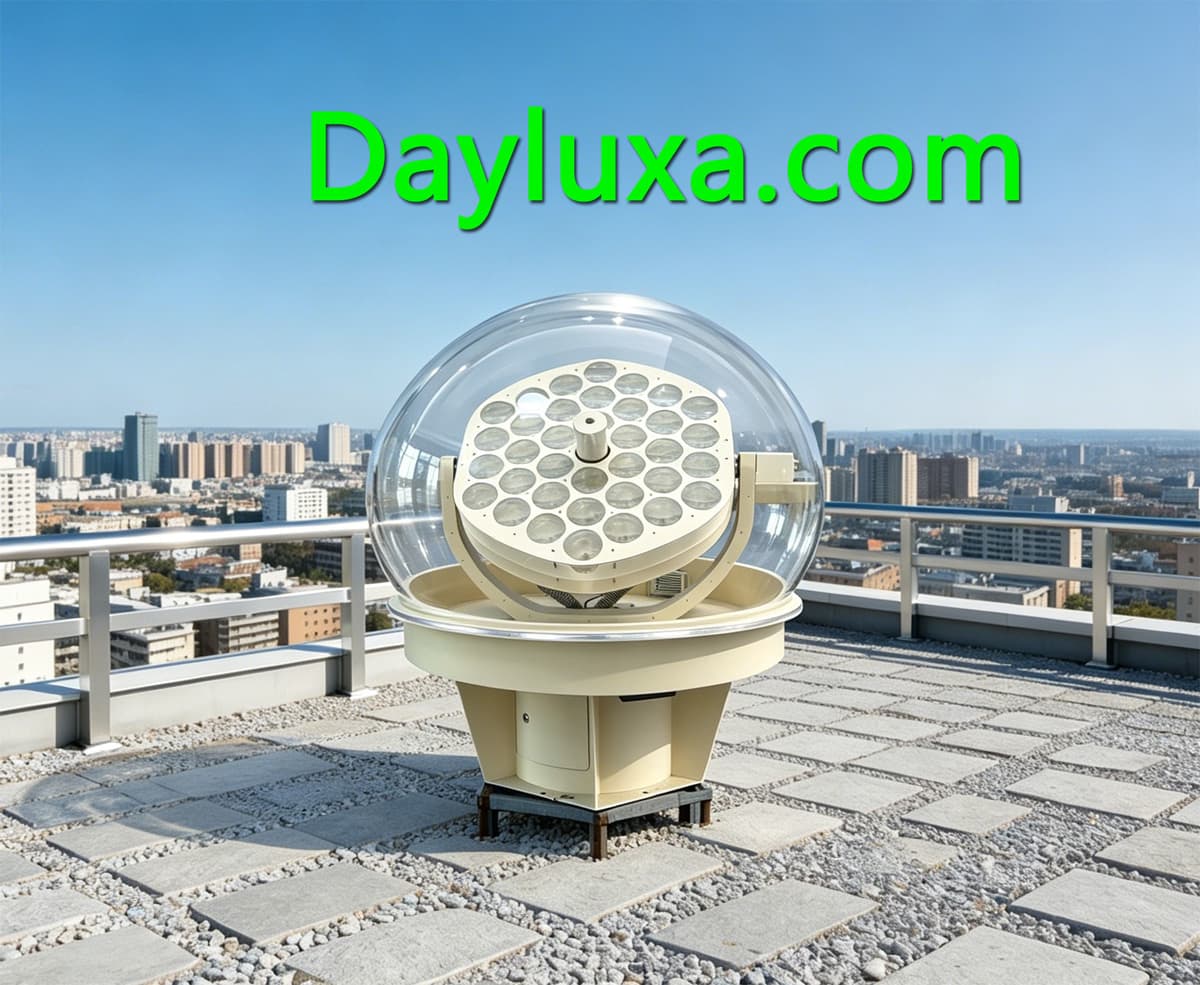
Tracking means a rooftop collector doesn't sit still hoping for the best. It moves. A set of Fresnel lenses — each about 100 millimeters in diameter, shaped like a series of concentric rings that bend light the way a curved lens does but in a flat profile — is mounted on a dual-axis motorized platform. A GPS chip determines the unit's exact geographic coordinates. An onboard computer calculates the sun's position using an astronomical algorithm that accounts for the date, time, latitude, and longitude. The motors adjust the lens array's azimuth and elevation continuously throughout the day, keeping every lens pointed directly at the sun within a fraction of a degree. Total power draw for the entire tracking and control operation: about 12 watts — roughly the same as an LED desk lamp.
Concentrating is the second step. Because of its concentric ring geometry, a Fresnel lens focuses sunlight onto a single point — the tip of an optical fiber — with far higher intensity than a flat piece of glass. Think of the difference between a magnifying glass held casually in sunlight versus one held precisely at its focal point. The active system holds it at the focal point, always, because it tracks.
Transporting is where the category distinction becomes unambiguous. The concentrated sunlight enters a bundle of quartz optical fibers — each with a core diameter of about 1.5 millimeters, made from low-hydroxyl high-purity silica glass. The fibers carry light through total internal reflection: the boundary between the fiber's core and its cladding layer acts as a near-perfect mirror when light hits it at a shallow enough angle, trapping photons inside and guiding them forward. Because the glass is exceptionally pure — attenuation below 10 decibels per kilometer — a photon can travel 100 meters through these fibers and still emerge with measurable brightness at the other end.
This is what passive systems cannot do: bend light around corners, split it between rooms, thread it through existing cable trays, and deliver it to spaces with no line-of-sight to the sky. An active system's fibers can be routed like electrical conduit. One rooftop collector can feed multiple rooms on different floors. The light travels through walls, between floors, around structural beams — wherever the fiber can go, the sunlight follows.
The fiber also filters. Quartz glass naturally absorbs ultraviolet radiation below 380 nanometers and infrared radiation above 780 nanometers. What emerges at the indoor fixture is visible light only — the 400-to-700 nanometer band that humans perceive as color and brightness. No UV to fade artwork or degrade sensitive materials. No IR to add thermal load to air-conditioned spaces. This filtering happens inside the fiber itself; it requires no additional coatings or filters.
At the delivery end, each fiber terminates in a diffusion fixture mounted on the ceiling. The fixture spreads the concentrated beam into a cone of soft, even illumination — indistinguishable in quality from light coming through a window. Each fixture also contains an LED backup source. When clouds roll in or the sun sets, the LED activates automatically, maintaining continuous illumination without a visible transition. The room doesn't go dark at 4 PM on an overcast afternoon. It switches over silently.
These four functions — tracking, concentrating, transporting, filtering — form a system that does not passively admit light. It actively manages it from collection to delivery. In a Dayluxa DY60 configuration, 60 lenses feed 60 fibers, serving approximately 180 square meters of indoor space from a single rooftop collector weighing 78 kilograms. The system's variable is not "how close is the roof" but "how much daylight does this space need, and how far must it travel."
100 Meters Through a Glass Thread: What the Numbers Say
The claim that sunlight can travel 100 meters through a fiber thinner than a pencil lead invites healthy skepticism. Measured data answers it.
Tests conducted with a single quartz fiber under outdoor illuminance of approximately 150,000 lux — a clear midday sky — produce the following readings:
| Fiber Length | Distance from Fixture | Illuminance (lux) | Contextual Reference |
|---|---|---|---|
| 30 m | 1 m | 1100 | Exceeds standard office requirement (400-500 lux) |
| 30 m | 2 m | 450 | Meets standard office lighting requirement |
| 30 m | 3 m | 150 | Suitable for supplemental lighting |
| 50 m | 1 m | 800 | Satisfies office and study requirements |
| 50 m | 2 m | 320 | Adequate for basic office tasks |
| 100 m | 1 m | 200 | Underground space supplemental lighting |
| 100 m | 2 m | 80 | Ambient light level |
| 100 m | 3 m | 45 | Background and guidance lighting |
Several things in this table deserve attention. At 30 meters and 1 meter from the fixture, a single fiber delivers 1,100 lux — more than double the 400-500 lux that the World Health Organization recommends for standard office work. At 2 meters, the reading holds at 450 lux, right at the office threshold. With three fibers per fixture — the recommended configuration — these values multiply.
The attenuation curve is gradual, not catastrophic. Moving from 30 meters to 100 meters reduces the 1-meter reading from 1,100 lux to 200 lux — a decline of roughly 82%. That may sound steep, but context matters. A passive tubular daylighting device loses 40% of its light in the first 3 meters. By 6 meters, it's finished. An active fiber system still produces 200 lux at 100 meters — not enough to be the sole light source for detailed work at that distance, but more than sufficient as a daylight supplement, and at a distance no passive system can reach.
The physical property enabling this is the attenuation rate: below 10 dB/km. In practical terms, 10 dB represents a factor-of-10 reduction in light intensity. Over 100 meters — one-tenth of a kilometer — the intrinsic loss is about 1 dB, or approximately 20%. Remaining losses come from coupling efficiency at the lens-to-fiber interface and from the fixture's diffusion optics — both design variables rather than physical limits.
But the number on the light meter is only part of what's delivered. Because the transport medium is glass rather than reflective aluminum, the spectral composition of the light remains intact. An LED can be tuned to 4,000K or 5,000K, but its spectral power distribution will always be spiky — high at certain wavelengths, low or absent at others — because LEDs produce light through phosphor-converted blue emission, not through thermal radiation across a continuous spectrum. The sun produces a smooth, continuous spectral curve from violet through red. When that light travels through a quartz fiber, the fiber attenuates all visible wavelengths roughly equally. What emerges is still sunlight — dimmer, but with the same spectral shape. Color rendering index: 100. No artificial light source can claim this.
Where the Equation Changes
The technology matters only to the extent that it changes what's possible in real buildings. And what changes is this: the set of spaces that can receive natural light expands from "within 6 meters of the roof" to "anywhere a fiber can reach."
For schools, this carries a specific, measurable implication. The Chinese Center for Disease Control and Prevention reports that classrooms with natural daylight see myopia rates 25-30% lower than artificially lit equivalents. This isn't a lighting quality issue — it's a biological response to the specific spectral and intensity characteristics of sunlight, including violet light in the 360-400 nanometer range shown in multiple studies to suppress axial elongation of the eye. Underground or windowless classrooms, which exist in dense urban schools where above-ground space is at a premium, suddenly become candidates for natural light.
For hospitals, the stakes are different. A University of Pittsburgh study found that patients in rooms with natural daylight had hospital stays 16% shorter on average than those in windowless rooms, controlling for condition severity. The mechanism isn't fully understood, but the leading hypothesis points to circadian regulation: immune function, tissue regeneration, and inflammation control are all clocked by the light-dark cycle. A patient whose circadian rhythm is disrupted by 24-hour artificial lighting is fighting illness with a body that doesn't know what time it is.
For museums and galleries, the concern inverts. Natural light is desirable for its color accuracy, but ultraviolet radiation — present in unfiltered sunlight — causes pigment fading, fiber embrittlement, and surface degradation in artifacts. The UV-filtering property of quartz fiber, which absorbs wavelengths below 380 nanometers before they reach the fixture, removes this trade-off. A gallery can display a 16th-century textile under genuine sunlight without accelerating its deterioration.
For underground parking garages, the value is simpler but no less significant. These spaces run lighting 24 hours a day. Light quality — a flat, cool-white LED spectrum — is irrelevant to a parked car. But to the people who walk through these spaces daily, the difference between artificial-only and daylight-supplemented illumination registers at a level below conscious awareness. It's the difference between a space that feels like a utility cavity and one that feels like part of a building.
The common thread across these scenarios is not cost or efficiency. It's that active daylighting removes the physical constraints that have, for centuries, made certain spaces structurally incapable of receiving natural light. The roof is no longer the ceiling. Distance is a design parameter, not a disqualification.