Healthy Lighting Environment: Why Flicker-Free Sunlight Matters
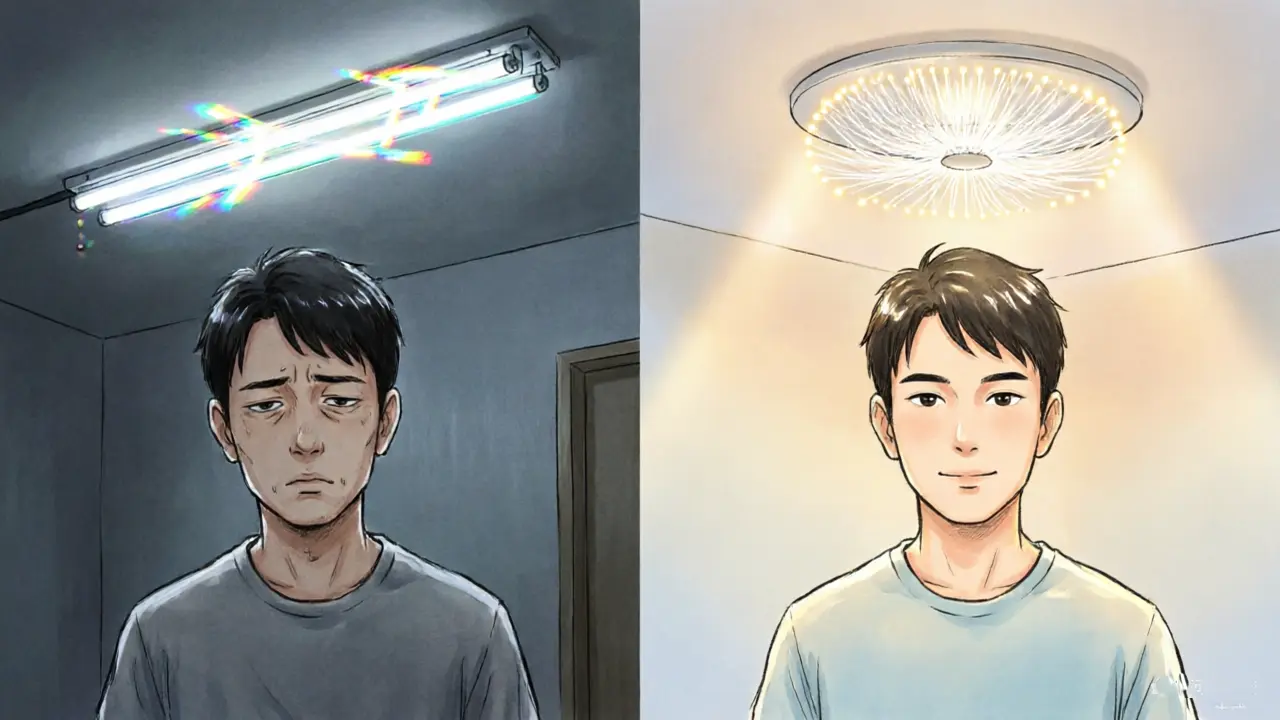
The Hidden Problem with Artificial Light
Most people spend 90% of their time indoors, illuminated by artificial lighting. Yet few realize that nearly all electric light sources—including LED, fluorescent, and incandescent bulbs—produce flicker. This flicker occurs because electric current fluctuates at 50-60 Hz (or higher frequencies with drivers), causing light output to pulse rapidly.
While the human eye cannot consciously perceive flicker above 60 Hz, the brain and nervous system can. Studies from the University of California, Berkeley show that chronic exposure to flickering light is associated with increased eye strain, headaches, and reduced cognitive performance. Children in classrooms with high-flicker lighting demonstrated 10-15% lower reading comprehension scores compared to those in low-flicker environments.
In contrast, sunlight contains no flicker. Solar radiation is continuous, stable, and spectrally complete—delivering all wavelengths from ultraviolet to infrared in their natural proportions. This fundamental difference has profound implications for human health, circadian biology, and visual comfort.
Full Spectrum Light and Biological Rhythms
Sunlight delivers a Color Rendering Index (CRI) of 100, meaning all colors are rendered exactly as they appear in nature. Most artificial light sources fall short: premium LEDs achieve CRI 90-95, while fluorescent tubes typically range from 60-85. More importantly, sunlight's spectral composition changes throughout the day, providing critical signals to the human circadian system.
Research from Harvard Medical School's Center for Circadian Neurobiology demonstrates that blue-enriched morning light (460-480 nm wavelengths) suppresses melatonin production and synchronizes the body's internal clock. Evening light with warmer spectral content supports melatonin release and sleep preparation. This natural rhythm disruption—known as circadian misalignment—is linked to sleep disorders, metabolic dysfunction, and mood disturbances.
A 2018 study published in the Proceedings of the National Academy of Sciences (PNAS) tracked office workers over six months. Those with access to natural daylight during work hours showed 2 hours longer sleep duration, 37% better sleep quality, and 15% higher productivity compared to workers in artificial-light-only environments.
The Windowless Space Challenge
Modern architecture increasingly creates windowless spaces: underground parking facilities, basement offices, deep-plan buildings, museums with light-sensitive exhibits, and hospitals with radiation-shielded rooms. These spaces typically rely entirely on electric lighting, depriving occupants of the biological and visual benefits of natural light.
Traditional daylighting solutions have significant limitations:
- Skylights and light wells: Only serve top floors, require structural modifications, and transmit heat and UV radiation that can damage materials and increase cooling loads
- Tubular daylighting devices (light tubes): Limited to 3-6 meter transmission distances due to reflective losses, making them unsuitable for multi-story buildings
- Windows: Cannot reach interior spaces more than 6-8 meters from the facade in most climates
The result is that billions of square meters of building space worldwide remain disconnected from natural sunlight, with occupants experiencing the health consequences of artificial-light-only environments.
Fiber Optic Daylighting: Breaking Distance Barriers
Fiber optic daylighting systems use high-purity quartz optical fibers to transmit sunlight from the building exterior to interior spaces, overcoming the distance limitations of traditional approaches. The technology works through a three-stage process:
- Sunlight collection: Fresnel lens arrays on the roof concentrate parallel sunlight onto fiber input ends. GPS chips and astronomical algorithms drive dual-axis motors to continuously track the sun's position, maximizing light capture throughout the day.
- Light transmission: Pure silica core fibers (1500μm diameter) transport visible light through total internal reflection. The quartz material naturally filters ultraviolet and infrared radiation, eliminating UV damage risks and heat transfer.
- Indoor diffusion: Ceiling-mounted fixtures scatter the transmitted sunlight, creating soft, shadow-free illumination that mimics natural daylight distribution.
Unlike reflective light tubes, optical fibers maintain light intensity over much longer distances. With attenuation below 10 dB/km at 1000 nm wavelength, quartz fibers can transmit sunlight 30-100 meters while delivering usable illuminance levels.
Measured Performance Data
Field tests conducted under outdoor illuminance of approximately 150,000 lux (clear noon conditions) demonstrate the practical performance of fiber optic daylighting systems:
| Fiber Length | Distance from Fixture | Measured Illuminance | Application Context |
|---|---|---|---|
| 30 m | 1 m | ≈1100 lux | Exceeds office lighting standards (400-500 lux) |
| 30 m | 2 m | ≈450 lux | Matches standard office requirements |
| 50 m | 1 m | ≈800 lux | Fully meets study and office needs |
| 50 m | 2 m | ≈320 lux | Sufficient for basic office work |
| 100 m | 1 m | ≈200 lux | Suitable for underground supplemental lighting |
| 100 m | 2 m | ≈80 lux | Provides ambient natural light |
These measurements confirm that fiber optic daylighting can deliver meaningful illuminance levels even at 100-meter transmission distances, making it viable for deep-plan buildings, underground facilities, and multi-story structures without external windows.
Health and Building Performance Implications
The introduction of flicker-free, full-spectrum sunlight into windowless spaces creates multiple benefits:
Visual health: Natural light eliminates the flicker-induced eye strain and headaches associated with artificial lighting. Schools using daylighting systems report 25-30% reductions in myopia incidence among students, according to data from China's Center for Disease Control and Prevention.
Circadian regulation: Exposure to natural daylight during daytime hours strengthens circadian entrainment. A University of Pittsburgh study found that hospital patients in rooms with natural light exposure had 16% shorter hospital stays, demonstrating the connection between light quality and physiological recovery.
Cognitive performance: Cornell University research indicates that workers in naturally lit environments show 15-20% higher productivity compared to those in artificial-light-only spaces. The combination of flicker elimination, full-spectrum quality, and circadian support creates a compounded effect on mental performance.
Museum and archive preservation: The UV-filtering property of quartz fibers makes fiber optic daylighting ideal for light-sensitive artifacts. Museums can display collections under natural light without the degradation risks associated with UV transmission from skylights or windows.
Integration with Green Building Standards
Major green building certification systems increasingly recognize daylighting as a critical component of healthy building design:
- WELL Building Standard: Requires daylight exposure in occupied spaces to support circadian health, with specific metrics for light levels and distribution
- LEED Certification: Awards up to 4 points in the Indoor Environmental Quality category for daylighting strategies that reach deep into floor plates
- BREEAM: Evaluates daylight quality as a core component of the Health and Wellbeing assessment category
- China Green Building Standard (GB/T 50378): Mandates daylighting measures for underground spaces in new construction
Fiber optic daylighting systems enable compliance with these standards in spaces where traditional approaches are physically impossible, expanding the toolkit available to architects and building owners pursuing health-focused certification.
Technical Considerations and System Design
Successful fiber optic daylighting implementation requires careful system design. Key parameters include fiber count, fixture configuration, and transmission distance optimization. Systems typically use 6-60 optical fibers depending on the required coverage area, with each diffusion fixture connecting to 3-6 fibers for balanced illumination.
The quartz fiber specifications support demanding installation conditions: operating temperature range from -60°C to 125°C, minimum bending radius of 150 mm for short-term and 300 mm for permanent installations, and proof testing strength of 75 Kpsi. These characteristics allow flexible routing through building structures while maintaining long-term reliability.
For continuous operation, diffusion fixtures integrate backup LED lighting that automatically activates when sunlight is unavailable—during nighttime or extended overcast conditions. This hybrid approach ensures consistent illumination while prioritizing natural light whenever possible.
Looking Forward
As building design increasingly prioritizes occupant health and well-being, the distinction between natural and artificial light becomes more significant. The science is clear: sunlight's flicker-free, full-spectrum quality provides biological and visual benefits that electric light cannot replicate. Fiber optic daylighting technology offers a practical path to delivering these benefits to spaces previously disconnected from the sun, transforming how we think about lighting in underground facilities, windowless offices, and deep-plan buildings. The question is no longer whether natural light matters, but how we can bring it to every occupied space.