Roof Daylighting Systems: Transforming Deep Building Spaces With Natural Light
Field-deployed case study · Fiber-optic daylighting application
The Human Need for Natural Light
Natural light is not merely an aesthetic preference—it is a biological necessity. Human circadian rhythms, which regulate sleep patterns, hormone production, and cognitive function, depend on exposure to full-spectrum sunlight throughout the day. The World Health Organization recommends office environments maintain illuminance levels between 300-500 lux to support visual comfort and productivity. Yet modern architecture increasingly pushes functional spaces underground or deep into building cores, creating environments where natural light cannot reach.
Research from Cornell University demonstrates that workers in naturally lit offices experience 15-20% higher productivity compared to those under artificial lighting. A study by the Chinese Center for Disease Control found that students in classrooms with adequate natural daylight have 25-30% lower rates of myopia development. These findings underscore a fundamental challenge: how do we deliver authentic sunlight to spaces that architecture has rendered inaccessible?
The Architectural Daylighting Challenge
Contemporary building design faces a paradox. Urban density demands vertical expansion and underground utilization, while health-conscious design standards—such as LEED, WELL, and BREEAM certifications—increasingly emphasize access to natural daylight. Underground parking garages, basement offices, interior classrooms, and deep-plan commercial spaces all present the same problem: they exist beyond the reach of conventional daylighting strategies.
Traditional solutions have significant limitations. Skylights and light wells serve only top-floor spaces. Tubular daylighting devices (light tubes) can transmit light 3-6 meters vertically but struggle with horizontal distribution and multi-floor penetration. Neither approach addresses the fundamental constraint that most occupied spaces in modern buildings are not adjacent to exterior walls or rooftops.
How Roof Daylighting Systems Work
Modern roof daylighting systems, particularly fiber optic daylighting technology, operate on a three-stage process that decouples light collection from light distribution. This separation is what enables sunlight to reach spaces previously considered unreachable.
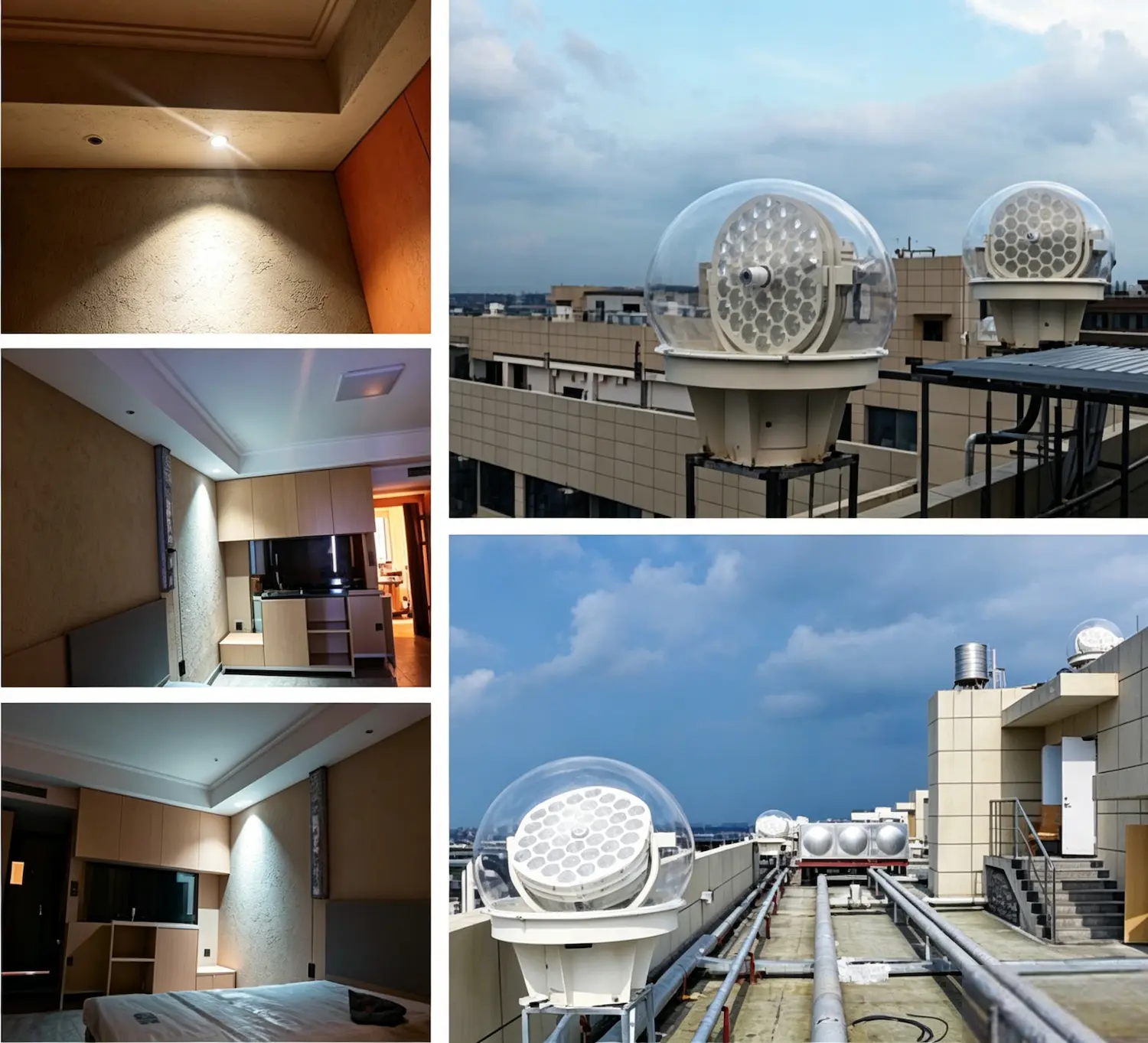
The first stage involves sunlight collection through Fresnel lens arrays mounted on the roof. These precision optical components focus parallel sunbeams onto fiber optic entry points. A GPS chip combined with astronomical algorithms drives a dual-axis motor system that continuously tracks the sun's position, maintaining optimal focus throughout the day. A single collector unit like the Dayluxa DY60 uses 60 Fresnel lenses, each 100mm in diameter, to gather sufficient light intensity.
The second stage is transmission through high-purity quartz optical fibers. These fibers, with a core diameter of 1500μm and numerical aperture of 0.37, operate on the principle of total internal reflection. Light entering one end bounces along the fiber walls without escaping, traveling distances of 30-100 meters with attenuation below 10 dB/km. Critically, the quartz material filters out ultraviolet (UV) and infrared (IR) radiation, delivering only visible light without heat gain or UV damage to interiors.
The third stage is diffusion through specialized fixtures that scatter the concentrated fiber-delivered light into soft, uniform illumination. These fixtures often incorporate LED backup sources that automatically activate during cloudy conditions or at nighttime, ensuring continuous lighting availability regardless of weather.
Performance Data: What Numbers Tell Us
Laboratory and field measurements provide concrete evidence of fiber optic daylighting performance. Testing conducted under approximately 150,000 lux outdoor conditions (clear midday sun) with single-core quartz fibers yields the following results:
| Fiber Length | Illumination Distance | Measured Illuminance | Comparison Reference |
|---|---|---|---|
| 30 meters | 1 meter | ≈1100 lux | Exceeds office lighting standards (400-500 lux) |
| 30 meters | 2 meters | ≈450 lux | Equal to standard office environment |
| 50 meters | 1 meter | ≈800 lux | Meets office and study requirements |
| 100 meters | 1 meter | ≈200 lux | Suitable for underground space supplementary lighting |
These figures demonstrate that even at 100 meters transmission distance, the system delivers usable illuminance levels appropriate for background and wayfinding lighting in underground environments. At shorter distances, the output rivals or exceeds conventional electric lighting standards.
Comparative Analysis: Fiber Optic vs. Traditional Methods
Understanding where fiber optic daylighting fits requires comparison with existing technologies. The following table contrasts three approaches across critical performance dimensions:
| Dimension | Fiber Optic Daylighting | Traditional Light Tube | Skylight / Light Well |
|---|---|---|---|
| Transmission Distance | 30-100 meters | 3-6 meters | Top floor only |
| Installation Flexibility | Flexible fiber routing through walls and floors | Requires vertical channel | Requires roof opening |
| Heat Impact | None (IR filtered out) | Present (heat transmission through reflection) | Significant (direct solar gain) |
| UV Radiation | None (UV filtered out) | Partial transmission | Complete transmission |
| Cloudy Day Performance | Available (LED backup) | Unavailable | Weak |
| Applicable Floors | Any floor level | Primarily top floors | Top floor only |
The data reveals that fiber optic systems are not competing with skylights or light tubes on their home turf—they are solving problems those technologies cannot address. The ability to deliver filtered, heat-free sunlight to basement levels, interior rooms, and multi-story depths represents a category of solution rather than an incremental improvement.
Industry Applications and Solutions
Roof daylighting systems find their strongest value proposition in scenarios where conventional daylighting is impossible. Underground parking garages represent perhaps the most common application—these spaces typically operate 24-hour artificial lighting at significant energy expenditure, yet occupants consistently report discomfort in permanently windowless environments. Fiber optic daylighting introduces genuine sunlight into circulation areas, stairwells, and elevator lobbies, transforming the user experience without structural modification.
Educational facilities present another compelling use case. Interior classrooms in dense urban schools often lack adequate natural light, contributing to eye strain and reduced attention spans. Installing fiber optic daylighting in these spaces directly addresses the myopia epidemic documented by health authorities, providing the full-spectrum illumination that artificial sources cannot replicate.
Healthcare environments benefit from the biologically active properties of natural sunlight. A University of Pittsburgh study found that patients in sunlit rooms experienced 16% shorter hospital stays compared to those in artificially lit rooms. Fiber optic systems can deliver this benefit to interior patient rooms, rehabilitation spaces, and diagnostic areas where windows are impractical.
Museums and galleries require careful light management to protect sensitive artifacts while providing adequate viewing conditions. The UV-filtered output of quartz fiber systems eliminates the primary cause of photochemical damage to paintings, textiles, and organic materials, making it possible to introduce natural-quality light into exhibition spaces without conservation risk.
Integration With Green Building Standards
Modern green building certification systems increasingly recognize that sustainability encompasses human health, not just energy reduction. LEED certification awards points under the "Indoor Environmental Quality" category for providing daylight access to occupied spaces—fiber optic systems can contribute up to 4 points in this category. The WELL Building Standard explicitly requires circadian lighting design, mandating that workspaces provide access to daylight that supports human biological rhythms.
In China, the Green Building Evaluation Standard (GB/T 50378) requires underground spaces to implement daylighting measures. As the country pursues its dual carbon goals, building design must balance energy efficiency with occupant wellbeing. Fiber optic daylighting addresses both dimensions: it provides zero-electricity daytime illumination while delivering the biologically active light spectrum that occupants need for health and performance.
Looking Forward
The evolution from skylights to light tubes to fiber optic daylighting represents a progression of increasing architectural freedom. Each generation expanded the range of spaces that could receive natural light, but the third generation—exemplified by systems like Dayluxa—fundamentally changed the relationship between building design and daylight access. Architects and engineers can now design deep-plan buildings, underground facilities, and interior spaces with the confidence that natural light delivery is a solved technical problem rather than an unattainable ideal.
As building codes evolve to reflect growing understanding of light's role in human health, and as certification systems raise the bar for indoor environmental quality, roof daylighting systems will transition from innovative specialty solutions to standard components of responsible building design. The question is no longer whether sunlight can reach deep building spaces, but how quickly the industry will adopt the technologies that make it possible.